

The University Library of Erlangen-Nuremberg (UB) oversees the graphic collections of Friedrich-Alexander University Erlangen-Nuremberg (FAU).
The Graphic Collection of the Margraves of Ansbach
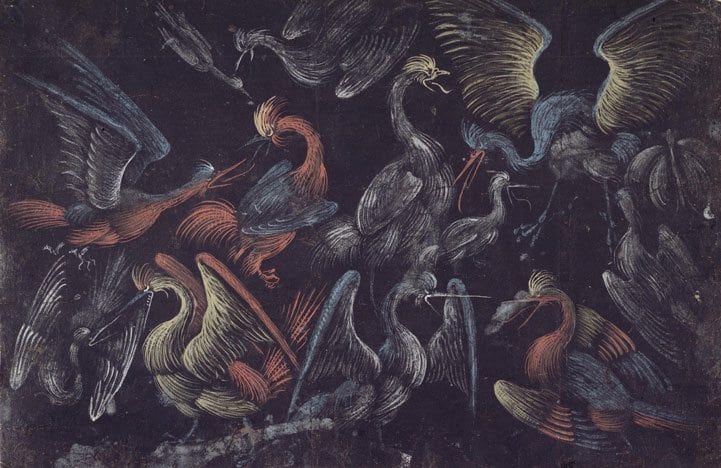
The Kämpfende Reiher, by Hans Pleydenwurff (born around 1420 in Bamberg), was probably created around 1470. The sheet measures approximately 19.1 x 28.4 cm. Unusually, Pleydenwurff applied the colored drawing with a fine brush onto a black background.
The collection comprises 1,987 drawings from the Middle Ages to the Baroque period. It is considered the only intact testimony to Nuremberg’s great tradition of art collecting. Initially, these pieces were kept in Nuremberg artists’ workshops in the 14th and 15th centuries out of technical necessity. These pieces included sample sheets, sketches, composition drafts, backup copies, and even independent works in color. Soon, these pieces attracted the interest of art-loving merchants. Since 2009, the hand drawings have been recataloged and digitized.
The collection of more than 1,000 woodcuts and 4,000 copperplate engravings and etchings features almost all of the great masters of the early modern period. The University Library alone owns numerous sheets by Albrecht Dürer, including works from the “Apokalypse” and the “Kleine Passion” and “Große Passion,” as well as 75 copperplate and steel engravings and etchings. This does not include the engravings from Dürer’s circle or the copies of his works. Additionally, there are a significant number of Nuremberg minor masters influenced by Dürer, including Hans Sebald, Barthel Beham, Virgil Solis, Georg Pencz, and Erhard Schön. Noteworthy pieces include the famous “Totentanz” by Hans Holbein the Younger, as well as works by Albrecht Altdorfer, Jost Amman, and Matthäus Merian. There is also a large collection of works by Lucas Cranach the Elder, Lucas Cranach the Younger, and their workshop. A catalog of the margrave’s prints was published in 1975 and 1980. All works have now been entered into the online catalog and digitized with funding from the bavarikon portal.
The Graphic Collection of the Margraves of Bayreuth
Several hundred copperplate engravings and etchings most likely originated from the Margrave Library of the Margraves of Brandenburg-Bayreuth. Margrave Friedrich von Bayreuth donated these prints to his newly founded state university in 1743. Their provenance was recorded in the project, “Katalogisierung und Digitalisierung der Druckgraphiken in der Graphischen Sammlung der FAU”.
Graphic Collection Luthardt
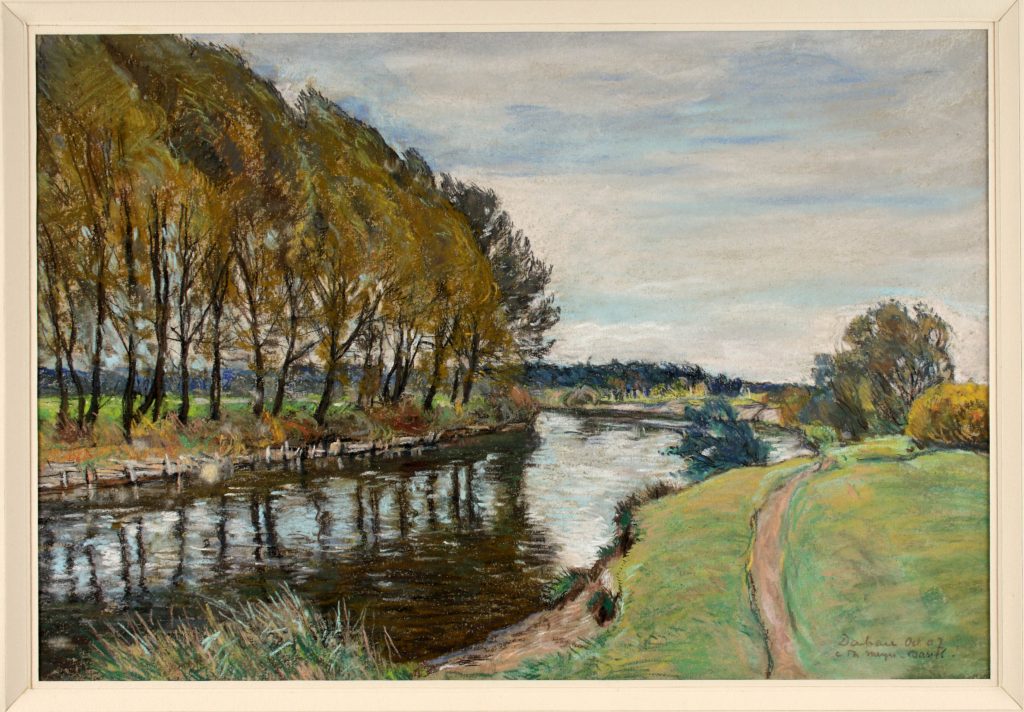
During the winter semester of 1883–84, Ernst Luthardt (1863–1937) studied law in Erlangen and likely came into contact with the Graphic Arts Collection at that time. Luthardt subsequently worked in administrative positions in several small towns in Franconia until 1917 and, after taking early retirement, retired to Prien am Chiemsee. Beginning in 1904, he devoted himself to collecting drawings and prints. Apparently, he intended from very early on to eventually bequeath his future collection to the University of Erlangen. Knowing that the Ansbach Collection covered exclusively the 14th through 18th centuries, he focused his collecting efforts primarily on the 19th and early 20th centuries. His collection, together with the Ansbach Collection, was intended to cultivate the students’ appreciation of art and serve as a resource for their studies. In 1931, he donated his collection to the University of Erlangen.
The collection comprises a total of more than 7,000 works, including 1,000 drawings and watercolors, as well as approximately 5,000 prints in all artistic genres, ranging from copperplate engravings, etchings, steel engravings, woodcuts, and linocuts to wood engravings and lithographs. Although Luthardt focused his collecting on the 19th and early 20th centuries, he decided to acquire approximately 1,200 prints by Old Masters, which served as a welcome addition to the Ansbach collection.
Luthardt had a special interest in German art—particularly that of southern Germany—and, within that, the Munich art scene in particular, while he acquired prints by artists from non-German-speaking regions only in exceptional cases.
The collection offers an outstanding overview of printmaking from the 19th century and the first quarter of the 20th century; the most renowned artists of this period are represented in it, and together with the prints from the Margrave’s collection, it spans 600 years of art history.
Collection Kamlah

Ruprecht Kamlah, like Ernst Luthardt an alumnus of FAU, donated in 2020 an art collection he had assembled over decades, consisting of works by German-speaking artists living in Rome in the late 18th and early 19th centuries. These artists, known as “German-Romans,” drew significant inspiration for their artistic work from their encounter with antiquity in Rome. However, the Kamlah Collection also includes works by artists who are no longer directly classified as “German-Romans” but rather follow in their footsteps.
The collection, which focuses on landscape depictions, illustrations of ancient ruins, and genre scenes, contains 160 watercolors and drawings by such renowned artists as Jacob Philipp Hackert, Joseph Koch, Johann Christian Reinhart, Ludwig Richter, Hans Thoma, Karl and Leopold Rottmann, Joseph Rebell, Johann Adam Klein, Franz Ludwig Catel, and many others.
However, the Kamlah Collection is of great significance not only from an artistic perspective but also from archaeological and art-historical standpoints. Many of the buildings and sites depicted by 18th- and 19th-century artists no longer survive in their original condition; some have been partially destroyed or restored.
Dr. Kamlah’s donation complements and enriches the Luthardt Collection in an outstanding way. Although the Luthardt Collection also contains numerous works by these artists, they consist almost exclusively of engravings and lithographs.