
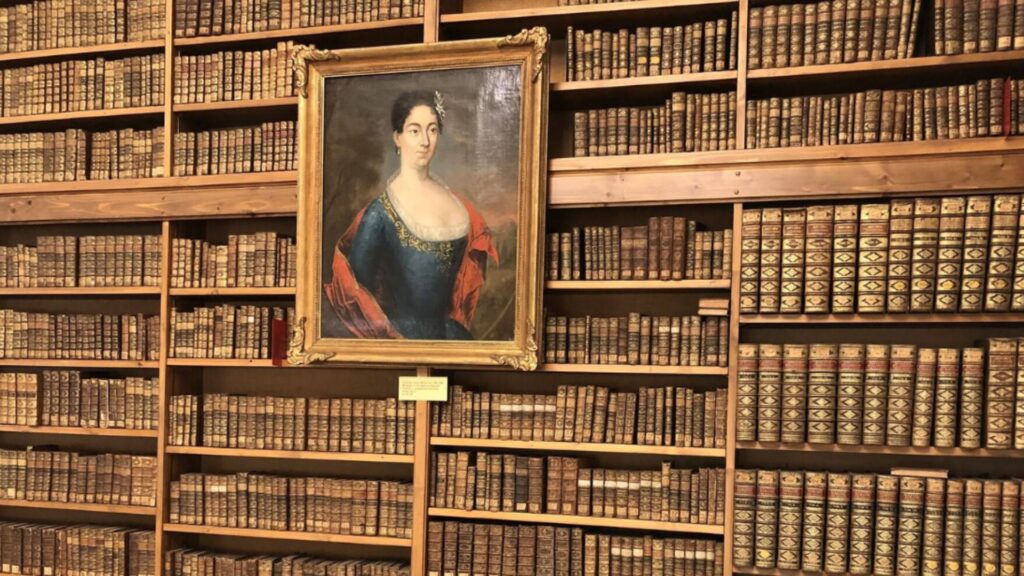
Together, the private library of the Margraves of Brandenburg-Bayreuth and the castle library of the Margraves of Brandenburg-Ansbach form a significant part of the University Library’s valuable historical holdings. These libraries reflect the status and interests of their owners through exceptional works of book art. They also reflect their use as the “official library” of a regent.
In 2018, to celebrate the university’s anniversary, the university library launched the research project “Virtual Reconstruction of the Margrave’s House Library in Bayreuth“.
The university library was founded when Margrave Friedrich established the University of Erlangen in 1743, as he left his alma mater, the Margrave’s House Library in Bayreuth, as the foundation for it.
Margrave Christian of Brandenburg-Bayreuth founded the Margrave’s house and court library. The oldest existing catalog dates from 1679 and likely includes the collection assembled by Margrave Christian and his son, Erdmann August (1615-1651), who died young. Other works listed under the heading “Ex nova Biblioteca” in the same catalog were probably acquired by his successor, Margrave Christian Ernst (1644-1712), his grandson. Margrave Christian Ernst acquired additional books for his library in 1701 and 1706.
In 1731, the Margrave’s personal collection was expanded to include the library of Margrave Karl August of Brandenburg-Kulmbach (1663–1731), who was a grandson of Margrave Christian. Subsequent margraves also continuously added to the library.
As of November 2020, the Margrave Library’s total collection includes approximately 3,000 physical volumes, numerous occasional writings, disputations, and maps, 92 incunabula, and 104 Latin, Greek, and German manuscripts. Additionally, there are several hundred copperplate engravings and etchings that are now part of the graphic arts collection at FAU.
On December 21, 1720, Margrave Wilhelm Friedrich of Brandenburg-Ansbach declared the princely household library a public state library. After the Franconian margraviates returned to the Prussian crown in 1791, King Frederick William III gifted the Ansbach State Library, also known as the Palace Library, to the Prussian University of Erlangen in the winter of 1805/06 due to the threat posed by Napoleon to Ansbach.
With more than 12,000 volumes, the Ansbach Palace Library was the most valuable addition to the University Library of Erlangen’s collection in its history. Among its items were a giant Romanesque Bible known as the Gumbertus Bible and two Gospels from the ninth and tenth centuries. These manuscripts, one probably created in Fulda and the other in Würzburg, are the oldest in the University Library’s collection. Additionally, several rare, leather-bound volumes and a manuscript from the collection of Hungarian King Matthias Corvinus (d. 1490) came to Erlangen. The Ansbach Castle Library also contained a collection of nearly 2,000 drawings and over 4,000 woodcuts, copperplate engravings, and etchings from the 14th to 18th centuries.
The Ansbach Castle Library is being reconstructed virtually. More than 2,000 volumes have already been assigned to it.
The margrave’s libraries also include the libraries of the Margravines Christiane Charlotte of Brandenburg-Ansbach, Wilhelmine of Brandenburg-Bayreuth, Friederike Louise of Brandenburg-Ansbach, and Sophie Caroline of Brandenburg-Bayreuth.
Christiane Charlotte of Württemberg (1694–1729), Margravine of Brandenburg-Ansbach, holds a special place among the Franconian margravines. She was not only a royal consort and mother of the heir apparent, but also, from 1723 until her untimely death in 1729, “Chief Guardian and Regent” of the Margraviate of Ansbach.
Her library cannot be compared to the private libraries of the other Franconian margravines. The collection comprised only 80 titles in 235 volumes, most of which are now held at the University Library of Erlangen-Nuremberg, with a small portion at the State Library of Ansbach. The reasons for such a small private library lie, on the one hand, in the fact that the princess had access to the large castle library and therefore likely maintained only a small reference library in her private chambers. On the other hand, she became regent of the Margraviate of Ansbach at the age of 29 and, given the scope of her governmental duties, likely had little time for reading compared to those princesses who did not have to perform political tasks. Her early death at the age of only 35 also prevented her from collecting books over a long period of time.
If one compares her book collection with the private libraries of other princesses, it becomes clear that she owned only the most important standard works on ancient history and literature. There are also hardly any plays or works of belles-lettres in her library. What stands out, however, is a considerable number of works on architecture—which can be explained by the princess’s extensive building projects—and the 17-volume work on international treaties, Foedera, Conventiones etc., which was likely of great importance to her as a regent.
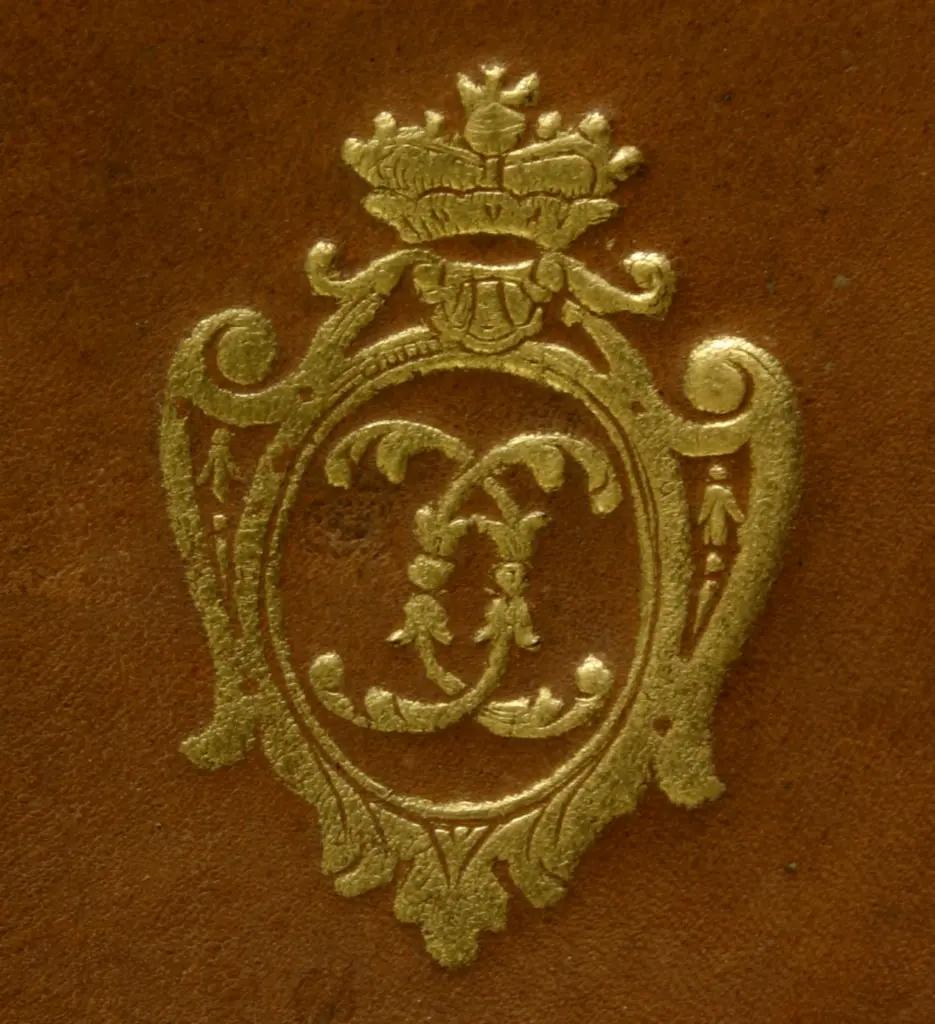
All of Christiane Charlotte’s Erlangen and Ansbach volumes are bound in brown calfskin. The edges are gilded, and her books bear the supralibros C & C in three different variations on the front cover and spine.
Wilhelmine of Prussia (1709–1758), Margravine of Bayreuth and the eldest sister of King Frederick II of Prussia, had already begun building a small book collection in Berlin; she continued collecting in Bayreuth from at least 1737 onward. On the occasion of the founding of the State University in Erlangen, she bequeathed her private library to the new institution in her will; In 1759, one year after her death, the collection arrived in Erlangen.
According to the Erlangen Catalog, it comprises 4,226 volumes. The majority consists of historical works, primarily primary sources, biographies, and memoirs. The Greek and Roman classics in French translation are almost complete, as is French belles-lettres from the Renaissance to the Wilhelmine era. In addition, there are theological and philosophical works, as well as a considerably smaller number of works in the natural sciences, mathematics, and medicine. The geography section consists almost exclusively of travelogues, although, remarkably, the entire library does not contain a single book on Franconia. Most of the books are in French; the rest are written in Italian, while only a few Bibles and a work on princely architecture are available in German.
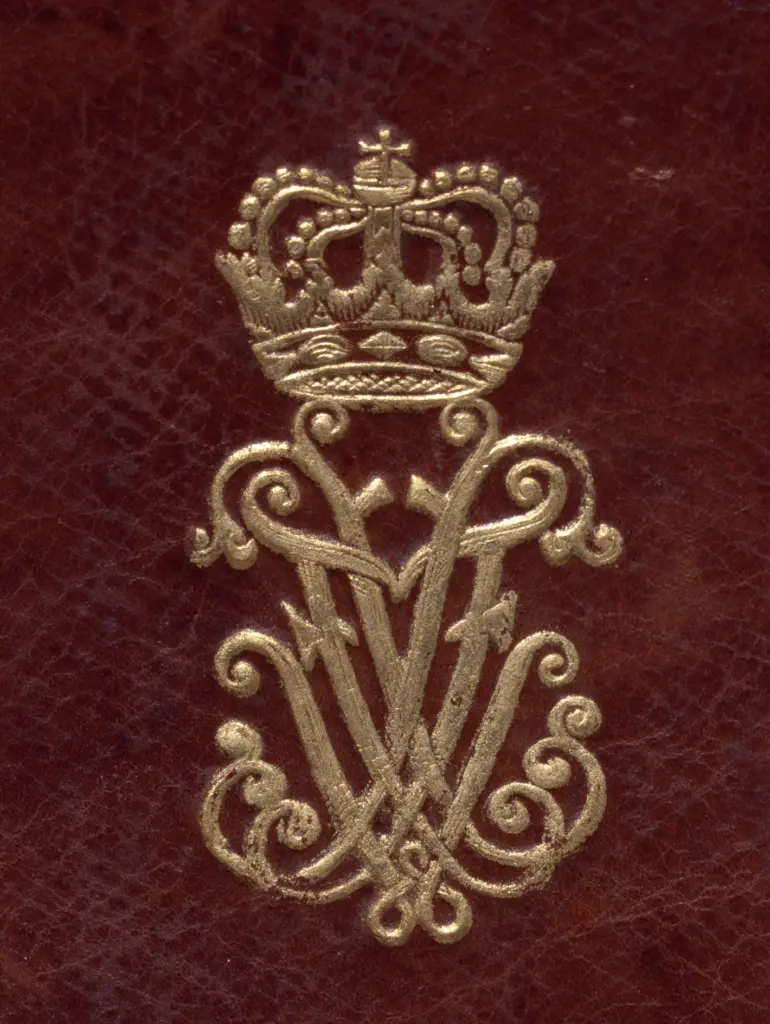
Most of the books are bound in brown calfskin and bear the princess’s supralibros: the initials FSW (Friederike Sophie Wilhelmine) beneath the Prussian royal crown. The majority of them are displayed in a closed case in the reading room of the Old University Library; the remaining volumes from her library are shelved in the general collection.
Friederike Louise of Prussia (1714–1784), Margravine of Brandenburg-Ansbach by marriage, was a younger sister of King Frederick II of Prussia and Wilhelmine of Prussia, Margravine of Brandenburg-Bayreuth. After her death, Friederike Louise’s private library was moved from her widow’s residence in Unterschwaningen to the Ansbach Castle Library and, when the castle library was transferred to the University Library of Erlangen in the winter of 1805–06, was divided between Ansbach and Erlangen. The larger part of her library, comprising 151 titles in 426 volumes, is located in Erlangen, while the smaller part, just under 100 titles, is housed in the State Library of Ansbach.
A quarter of her books are historical works, about 30 percent are anthologies or other works of fiction or light reading, and a small portion consists of theological works and travelogues. She owned a large number of devotional books, but no works on modern history, politics, or the natural sciences. The majority of her books, nearly 90 percent, are written in French, with the remainder divided roughly equally between German and Italian.
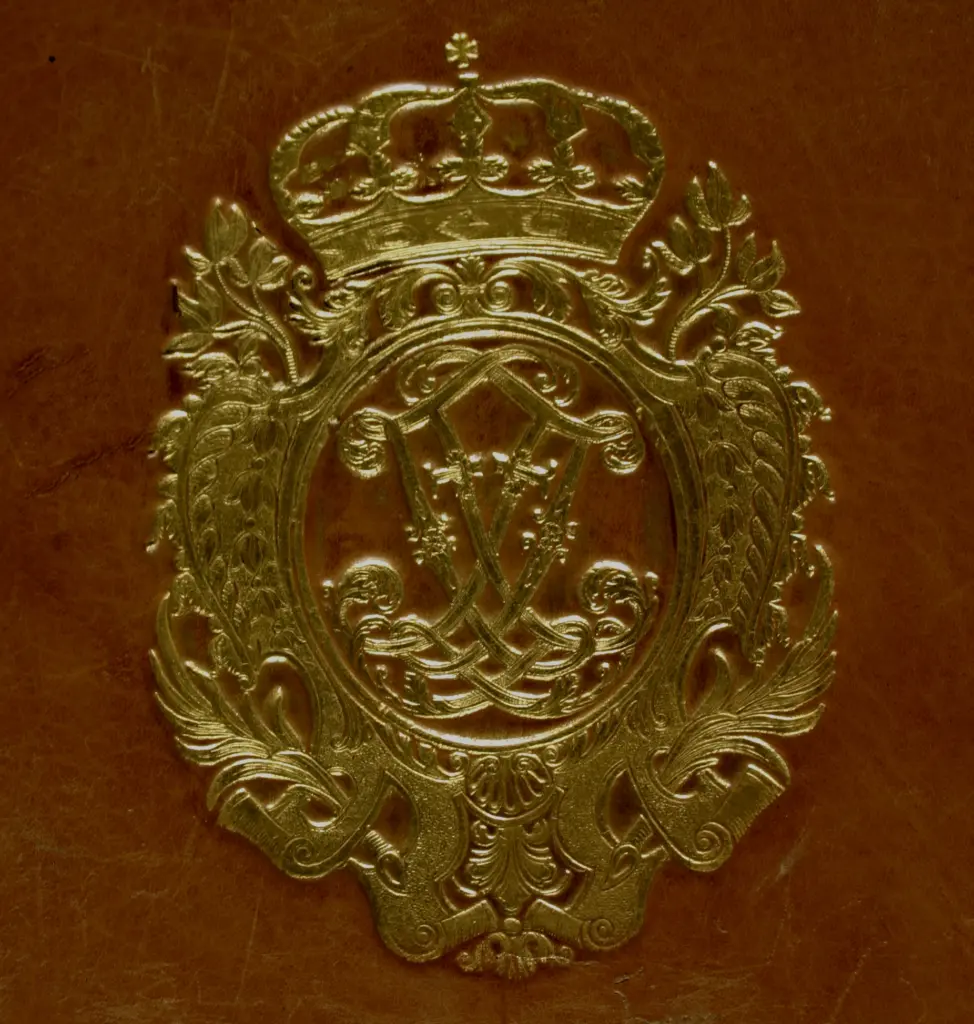
With a few exceptions, all of its volumes are bound in brown calfskin and bear the FL supralibros beneath the Prussian royal crown. The library is housed almost entirely in the historic reading room of the Old University Library.
Sophie Caroline of Brunswick-Wolfenbüttel (1737–1817), the last Margravine of Brandenburg-Bayreuth, was a daughter of Philippine Charlotte of Prussia, Duchess of Brunswick-Wolfenbüttel, a younger sister of Frederick II, King of Prussia. Sophie Caroline married into the House of Hohenzollern: In 1759, she married Margrave Frederick of Brandenburg-Bayreuth, the widower of her aunt Wilhelmine of Brandenburg-Bayreuth. Just four years later, the young princess was a widow and spent the rest of her life—53 years—at her widow’s residence in Erlangen, where she helped shape the cultural life of the city for decades.
According to the catalog, the Margravine owned a total of 616 works (1,661 volumes in all). Her library contains nearly all the major French authors, as well as a selection of Greek and Roman classics in French or Italian translation. In addition, there were a large number of historical works, memoirs, and travelogues, as well as comedies and tragedies in French, Italian, and English, and numerous novels. Several dictionaries (Latin, English, French, Italian, and German), a few atlases, and a small number of medical and scientific works were also part of her library.
In addition, she had subscriptions to two periodicals: the Magazin encyclopédique ou Journal des sciences (1807–1808) and the Journal des dames et des modes (1798–1817). The majority of her library consists of books in French; the remainder is divided almost equally between English and Italian, with a small portion written in German.
Sophie Caroline continued to expand her library through regular book purchases until her death. In accordance with her wishes, her library was bequeathed to the University Library of Erlangen after her death. Unlike the private libraries of the other margraves and margravines from Ansbach and Bayreuth, the books in her library bear no supralibros. Apart from minor losses, which according to the catalog are attributable to the castle fire of 1817, the library is still preserved in its entirety. More than half of her book collection is on display in the conference room of the Old University Library of Erlangen; the remainder is housed in the historical collection.